54k people like this. Be the first of your friends.
BiographyRobert Lanza
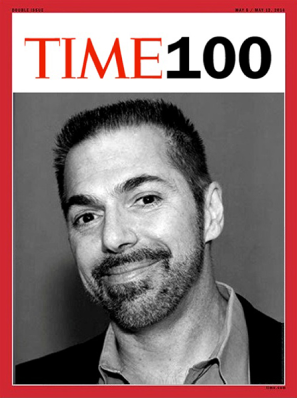
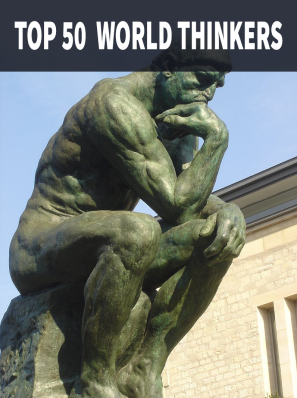
Robert Lanza is a renowned scientist and author whose peer-reviewed research spans the natural sciences, from biology to theoretical physics. TIME magazine recognized him as one of the “100 Most Influential People in the World,” and Prospect magazine named him one of the Top 50 “World Thinkers.” A U.S. News & World Report cover story called him “the living embodiment of the character played by Matt Damon in Good Will Hunting” and described him as a “genius,” a “renegade thinker,” and likened him to Einstein.
He has hundreds of scientific publications and over 30 books, including definitive references in the fields of stem cells, tissue engineering, and regenerative medicine. He is a former Fulbright Scholar and studied with polio-pioneer Jonas Salk and Nobel laureates Gerald Edelman (known for his work on the biological basis of consciousness) and Rodney Porter. He also worked closely (and co-authored papers in Science on self-awareness and symbolic communication) with noted Harvard psychologist BF Skinner. Dr. Lanza was part of the team that cloned the world’s first human embryo, the first endangered species, and published the first-ever reports of pluripotent stem cell use in humans.
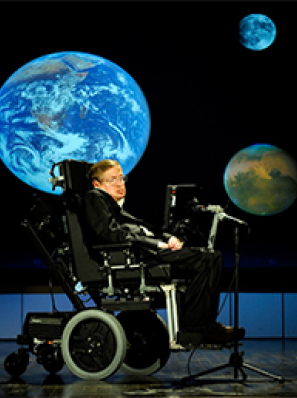
Lanza has also published peer-reviewed papers in theoretical physics, including in Annalen der Physik, which published Einstein’s theories of special and general relativity. In his papers on relativity, Einstein showed that time was relative to the observer. Lanza’s paper takes this one step further, arguing that time is not only relative to the observer, but that the observer is necessary for the emergence of time itself. Lanza also published a paper in JCAP, one of the leading journals in cosmology and astrophysics (which published Stephen Hawking’s groundbreaking work on the evolution of the early universe), which he co-authored with theoretical physicists Podolskiy and Barvinsky (one of the world’s leading theorists in quantum gravity and quantum cosmology). This new paper shows that networks of observers define the structure of physical reality/spacetime itself. The study represents a rare case in physics when the presence of observers drastically changes the behavior of observable quantities themselves not only at microscopic scales but also at very large spatio-temporal scales.
Education
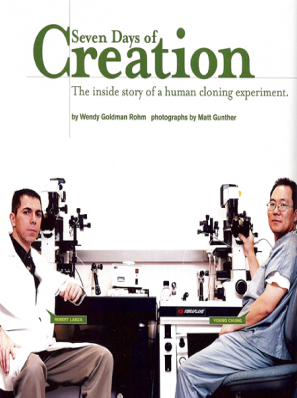
Dr. Lanza received his BA and MD degrees from the University of Pennsylvania, where he was both a University Scholar and Benjamin Franklin Scholar. He was also a Fulbright Scholar, and was part of the team that cloned the world’s first human embryo, as well as the first to successfully generate stem cells from adults using somatic-cell nuclear transfer (therapeutic cloning). Dr. Lanza’s work has been crucial to our understanding nuclear transfer and stem cell biology. In 2001 he was also the first to clone an endangered species (a Gaur), and in 2003, he cloned an endangered wild ox (a Banteng) from the frozen skin cells of an animal that had died at the San Diego Zoo nearly a quarter-of-a-century earlier.
Work and Research
Lanza and his colleagues were also the first to demonstrate that nuclear transplantation could be used to reverse the aging process and to generate immune-compatible tissues, including the first organ tissue-engineered from cloned cells. One of his greatest early achievements came from his demonstration that techniques used in preimplantation genetic diagnosis could be used to generate human embryonic stem (hES) cells without embryonic destruction. He and colleagues have also succeeded in differentiating human pluripotent stem cells into retinal (RPE) cells, and has shown that they provide long-term benefit in animal models of vision loss. Using this technology some forms of blindness may be curable, including macular degeneration and Stargardt disease, a currently untreatable form eye disease that causes blindness in teenagers and young adults. Lanza’s company (ACT) received FDA approval to begin clinical trials using them to treat degenerative eye diseases. These two clinical trials began in July 2011. Recently, ACT received similar approval for the first human embryonic stem cell trial in Europe. Surgeons at Moorfields Eye Hospital in London will inject healthy retinal cells into the eyes of patients with Stargardt’s macular dystrophy, hoping to slow, halt or even reverse the effects of the disease. The first person received the embryonic stem cell treatment earlier this year. The patient reports improved vision in the eye treated with the cells, which The Guardian said “represents a huge scientific achievement.”
Dr. Lanza and his colleagues published the first-ever report of human embryonic stem cells transplanted into human patients. Two clinical studies were initiated to establish the safety and tolerability of subretinal transplantation of hESC-derived RPE in patients with Stargardt’s macular dystrophy and dry age-related macular degeneration (AMD). After surgery, evidence confirmed cells had attached and continued to persist during the study. There were no signs of tumorigenicity or rejection in either patient. The patients who received the stem cell transplants say their lives have been transformed by the experimental procedure. During the observation period visual acuity improved from hand motions to 20/800 (and improved from 0 to 5 letters on the standard visual acuity chart) in the study eye of the patient with Stargardt’s disease, and vision also seemed to improve in the patient with dry AMD. One of the patients no longer needs a large magnifying glass to read and can reportedly thread a needle and has begun to go shopping on her own. The future therapeutic goal will of these studies will be to treat patients earlier in the disease processes, potentially increasing the likelihood of visual rescue.
In October 2014, Dr. Lanza and his colleagues published a follow-up paper in the journal The Lancet, providing the first evidence of the long-term safety and possible biologic activity of pluripotent stem cell progeny into humans with any disease. “For a nice two decades scientists have dreamt about using human embryonic stem cells to treat diseases,” said Gautam Naik, Science Reporter at the Wall Street Journal “that day has finally come…scientists have used human embryonic stem cells to successfully treat patients suffering from severe vision loss.” RPE cells derived from embryonic stem cells were injected into the eyes of 18 patients with either Stargardt’s disease or dry-AMD. The patients were followed for more than three years, and half of them were able to read three more lines on the eye chart, which translated to critical improvements in their daily lives as well.
Lanza has been a major player in the scientific revolution that has led to the documentation that nuclear transfer/transcription factors can restore developmental potential in a differentiated cell. One of his recent successes was showing that it is feasible to generate functional oxygen-carrying red blood cells from human pluripotent stem cells. The blood cells were comparable to normal transfusable blood and could serve as a potentially inexhaustible source of “universal” blood. His team also discovered how to generate functional hemangioblasts – a population of “ambulance” cells – from hES cells. In animals, these cells quickly repaired vascular damage, cutting the death rate after a heart attack in half and restoring the blood flow to ischemic limbs that might otherwise have to be amputated.
Lanza and a team lead by Kwang-Soo Kim at Harvard University reported a safe method for generating induced pluripotent stem (iPS) cells. Human iPS cells were created from skin cells by direct delivery of proteins, thus eliminating the harmful risks associated with genetic manipulation.
This new method provides a potentially safe and non-controversial source of patient-specific stem cells for translation into the clinic. The Editors of the prestigious journal Nature selected Lanza and Kim’s paper on protein reprogramming as one of five “Research Highlights” of 2009. Discover magazine stated, “Lanza’s single-minded quest to usher in this new age has paid dividends in scientific insights and groundbreaking discoveries.” Fortune magazine called him “the standard-bearer for stem cell research.”
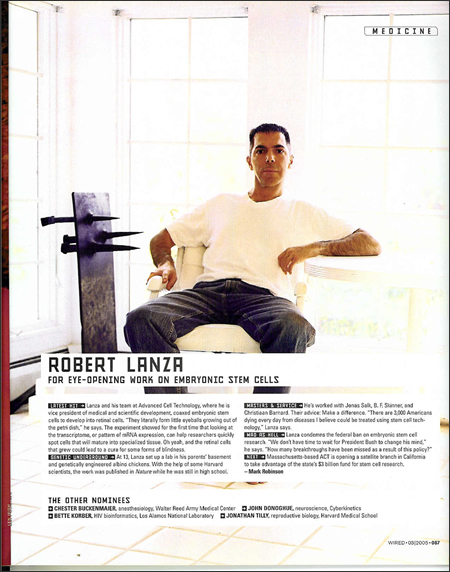
Dr. Lanza has been called the “Bill Gates of Science.” Dr. Lanza has received numerous awards, including TIME Magazine’s 2014 TIME 100 list of the “100 Most Influential People in the World,” the Top 50 “World Thinkers” (2015), including the 2013 Il Leone di San Marco award in Medicine (The Italian Heritage and Culture Committee, along with Regis Philbin [in Entertainment]); an NIH Director’s Award (2010) for “Translating Basic Science Discoveries into New and Better Treatments”; the 2013 “TOP 50 Global Stem Cell Influencers” (Terrapinn; the global stem cell community voted him Top 4 “Most Influential People on Stem Cells” along with James Thomson and Nobel laureate Shinya Yamanaka); the 2010 “Movers and Shakers” Who Will Shape Biotech Over the Next 20 Years (BioWorld, along with Craig Venter and President Barack Obama); the 2007 100 Most Inspiring People in the Life-Sciences Industry (PharmaVOICE, “For his discoveries ‘behind the medicines making a significant impact on the pipelines of today and of the future’”; the 2007 Outstanding Contribution in Contemporary Biology Award (Brown University, “For his groundbreaking research and contributions in stem cell science and biology”; the 2006 All-Star Award for Biotechnology (MA High Tech, for “pushing stem cells’ future”); the 2005 Rave Award for Medicine (Wired magazine, “For eye-opening work on embryonic stem cells”); Massachusetts Medical Society award; and The Boston Globe’s William O. Taylor award.
Lanza is listed in Who’s Who in America, Who’s Who in the World, Who’s Who in Medicine and Healthcare, Who’s Who in Science and Engineering, Who’s Who in American Education, and Who’s Who in Technology, among others. Dr. Lanza has served in numerous national and international leadership capacities, including Conference Co-Chairman, International Symposium on Stem Cells (Tianjin, China 2008); Stem Cell Advisory Committee, International Stem Cell Registry; He has given keynote addresses at dozens of national and international societies, including ASAIO (2001), Annual Molecular & Cellular Biology Symposium (2002), Biotechniques Live/Drug Discovery Technology & Development World Congress (2005), International Stem Cell Conference (2007), Tissue Engineering & Regenerative Medicine International Society (TERMIS)(2007), Translational Regenerative Medicine Forum (2010), among others.
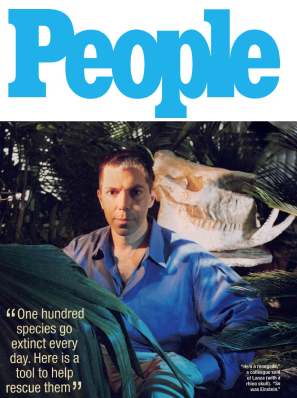
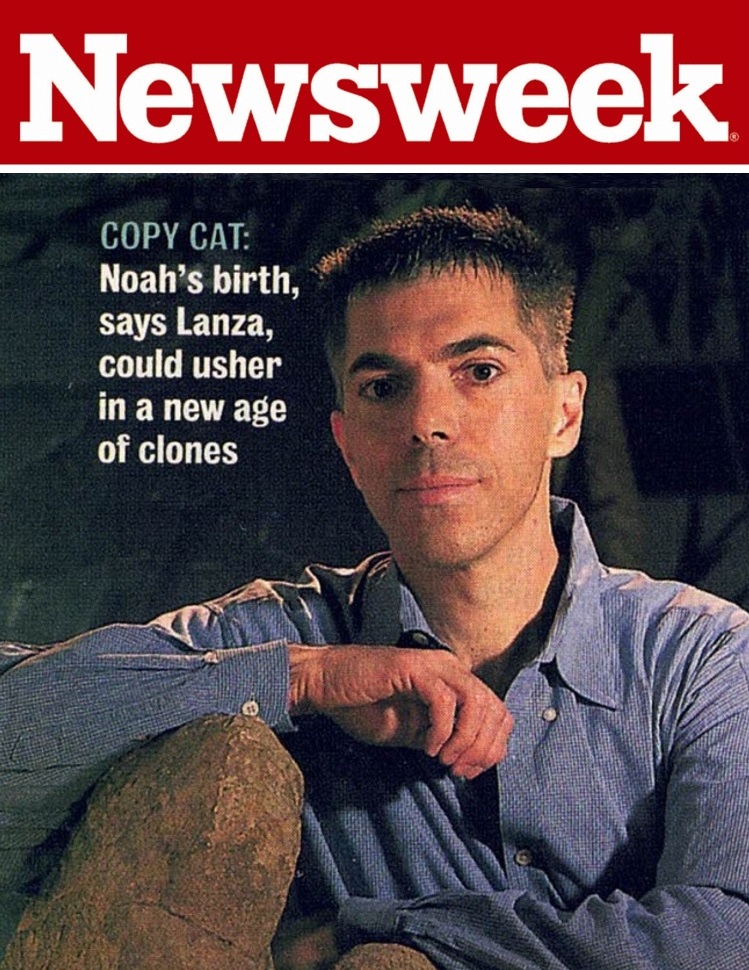
Dr. Lanza and his research have been featured in almost every media outlet in the world, including CNN, TIME, Newsweek, People, as well as the front pages of the New York Times, Wall Street Journal, Washington Post, among others. Lanza has worked with some of the greatest thinkers of our time, including Nobel laureates Gerald Edelman and Rodney Porter, renowned Harvard psychologist B.F. Skinner (the “Father of modern behaviorism”), Jonas Salk (discoverer of the Polio vaccine), and heart transplant pioneer Christiaan Barnard. His current research and work at Advanced Cell Technology focuses on stem cells and regenerative medicine and their potential to provide therapies for some of the world’s most deadly and debilitating conditions.
In 2007, Lanza published a feature article, “A New Theory of the Universe” in The American Scholar, a leading intellectual journal which has previously published works by Albert Einstein, Margaret Mead, and Carl Sagan, among others. His theory places biology above the other sciences in an attempt to solve one of nature’s biggest puzzles, the theory of everything that other disciplines have been pursuing for the last century. This new view has become known as Biocentrism. In 2009, he co-authored a book “Biocentrism: How Life and Consciousness are the Keys to Understanding the True Nature of the Universe” with leading astronomer Bob Berman. In biocentrism, space and time are forms of animal sense perception, rather than external physical objects. Understanding this more fully yields answers to several major puzzles of mainstream science, and offers a new way of understanding everything from the microworld (for instance, the reason for Heisenberg’s uncertainty principle and the double-slit experiment) to the forces, constants, and laws that shape the universe. Nobel laureate E. Donnall Thomas stated “Any short statement does not do justice to such a scholarly work. The work is a scholarly consideration of science and philosophy that brings biology into the central role in unifying the whole.”
Dr. Robert Lanza selected for the 2014 TIME 100 list of the hundred most influential people in the world, along with Pope Francis, Beyoncé, Vladimin Putin, Robert Redford, and other artists, pioneers, leaders, titans and icons.
“…he’s the standard-bearer for stem cell research” Lanza published a paper in The Lancet earlier this year detailing the results of early clinical trials involving two women suffering from macular degeneration. Lanza Featured in Fortune MagazineA UCLA…
Dr. Lanza selected as one of Prospect Magazine's "World Thinkers 2015." The thinkers were chosen for "engaging in original and profound ways with the central questions of the world today," as well as for their continuing significance…
Send in the Clones. Biologist Robert Lanza has a plan to help endangered species fight extinction. Earlier this year a group of scientists gathered at an Iowa farm to watch a cow give birth by C-Section.
“…his mentors described him [Lanza] as a “genius,” a “renegade” thinker, even likening him to Einstein.”
“Robert Lanza is the living embodiment of the character played by Matt Damon in the movie Good Will Hunting. Growing up…
“Since my 20s, I haven’t had to deal with the distractions that come from being able bodied. I’ve led a life of the mind. Stem cells may give you that same freedom, allowing you to pursue your…
Endangered species cloned. This is the first time one species has been cloned using the eggs and surrogate mother of an entirely different species. Scientists think they can use the same technique to resurrect the woolly mammoth…
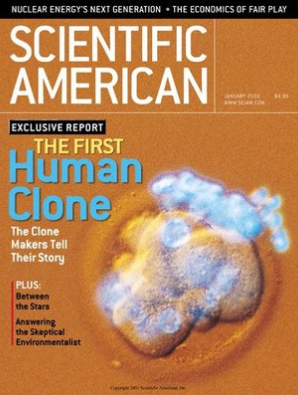
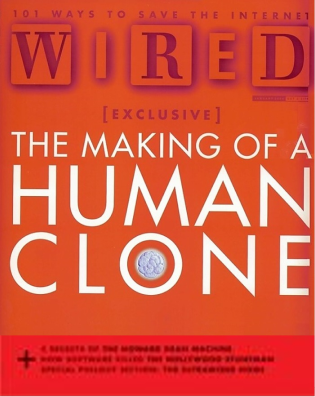
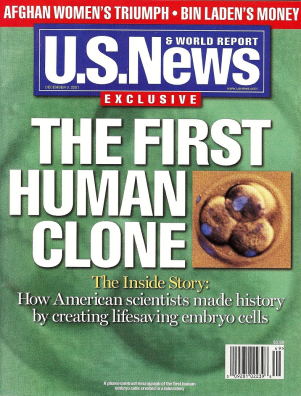
Lanza’s Early Cloning Research Featured on the Front Covers of Scientific American, Wired Magazine, and U.S.News & World Report, Among Others
Robert Lanza is the living embodiment of the character played by Matt Damon in the movie “Good Will Hunting.” Growing up underprivileged in Stoughton, Mass., south of Boston, the young preteen caught the attention of Harvard Medical School researchers when he showed up on the university steps having successfully altered the genetics of chickens in his basement. Over the next decade, he was “discovered” and taken under the wing of scientific giants such as psychologist B.F. Skinner, immunologist Jonas Salk, and heart transplant pioneer Christiaan Barnard. His mentors described him as a “genius,” a “renegade thinker,” even likening him to Einstein.